Most expense trackers stop at what you spent.
They answer how much went to food this month. They rarely answer the questions that change behaviour: is my spending drifting upward, which commitments could I quietly retire, and what does this EMI cost me in flexibility over ten years?
The gap is behavioural and consequential, not transactional. And because FlowSight never connects to a bank — you bring a CSV export, a manual entry, or a photo of a receipt — the first problem is making imported data trustworthy at all.
One normalized record, many focused engines.
Every source is normalized into a single transaction record, and every analytical surface — recurring detection, leak detection, behavioural insights, decision simulation, reports — reads from that one source of truth.
Machine extraction is a step in the pipeline, not the pitch. A receipt photo produces a draft; nothing becomes a transaction until the user confirms an editable, prefilled form. Findings are framed as observations, not judgments.
ingest          CSV · manual · receipt
  → normalize   strip UPI / IMPS / NEFT refs and noise
  → categorize  keyword match + confidence
  → transaction record
      ├ analytics          ├ recurring detection
      ├ leak detection     ├ simulation baseline
      └ insights & reports
Two clients, one backend, one schema authority.
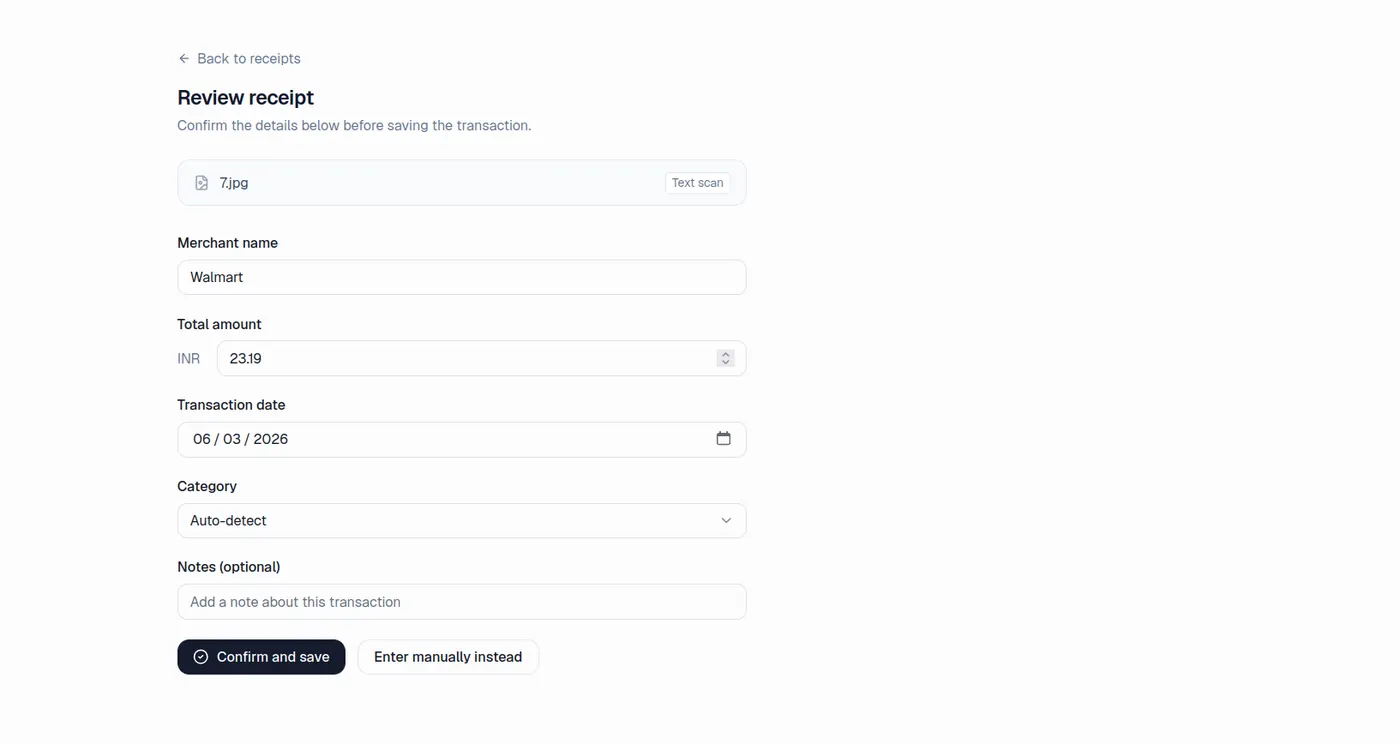
Making imported data trustworthy.
Header detection, not per-bank parsers
CSV import maps columns by alias — Date / Value Date, Narration / Particulars, Debit / Withdrawal / Money Out, Dr/Cr type columns, running balance — instead of carrying one parser per bank.
Balance-only statements, reconstructed
When a file carries no amount column at all, amounts are rebuilt from running-balance deltas, with confidence scoring and warnings.
One bad row never fails the batch
Per-row error recovery. A row whose amount can’t be resolved is reported as an error, never silently coerced to zero.
Catching the classic OCR mistake
An amount validator cross-checks line items and scores candidate labels, catching the case where a subtotal, VAT or GST line is read as the grand total — and assigns a confidence tier that drives an explicit warning.
Sessions that notice theft
Fifteen-minute access tokens with rotating fourteen-day refresh tokens, stored only as SHA-256 hashes and consumed on use. Replaying a spent token revokes every live session for that user.
Exports that can’t attack the accountant
Leading
=,+,-,@, tab and CR are neutralized in free-text CSV columns, so an export can’t execute as a spreadsheet formula (CWE-1236). The audit log is written in aREQUIRES_NEWtransaction so it survives the caller’s rollback.
What I chose, and what it cost.
- Why no bank connection?
- FlowSight never reaches into bank infrastructure: you bring the data. That keeps a whole class of integration out of the system, and moves the hard problem to ingestion — which is why ingestion gets header detection, balance reconstruction and per-row recovery rather than trust.
- Why is OCR review-first instead of automatic?
- Vision models misread totals; the subtotal-for-total mistake is common enough to have its own validator. Every engine reads the same record, so one wrong number saved silently would skew all of them. A draft the user confirms doesn’t.
- Why rate-limit in Postgres?
- So the limits hold across instances and survive restarts with the database the system already has — fixed-window counters, shared by every backend instance.
- Why are web tokens still in localStorage?
- It is a known limitation, and documented as one: localStorage is exposable to XSS. The fifteen-minute access-token lifetime bounds the blast radius. Moving to httpOnly cookies needs CSRF handling, and is on the roadmap rather than half-done.
- Why a desktop app at all?
- A Raycast-style popup for quick capture and top signals. It reuses the backend, the DTO types and the web app’s design system through an alias, so it adds a surface without duplicating logic — the backend needed only two additive changes for it.
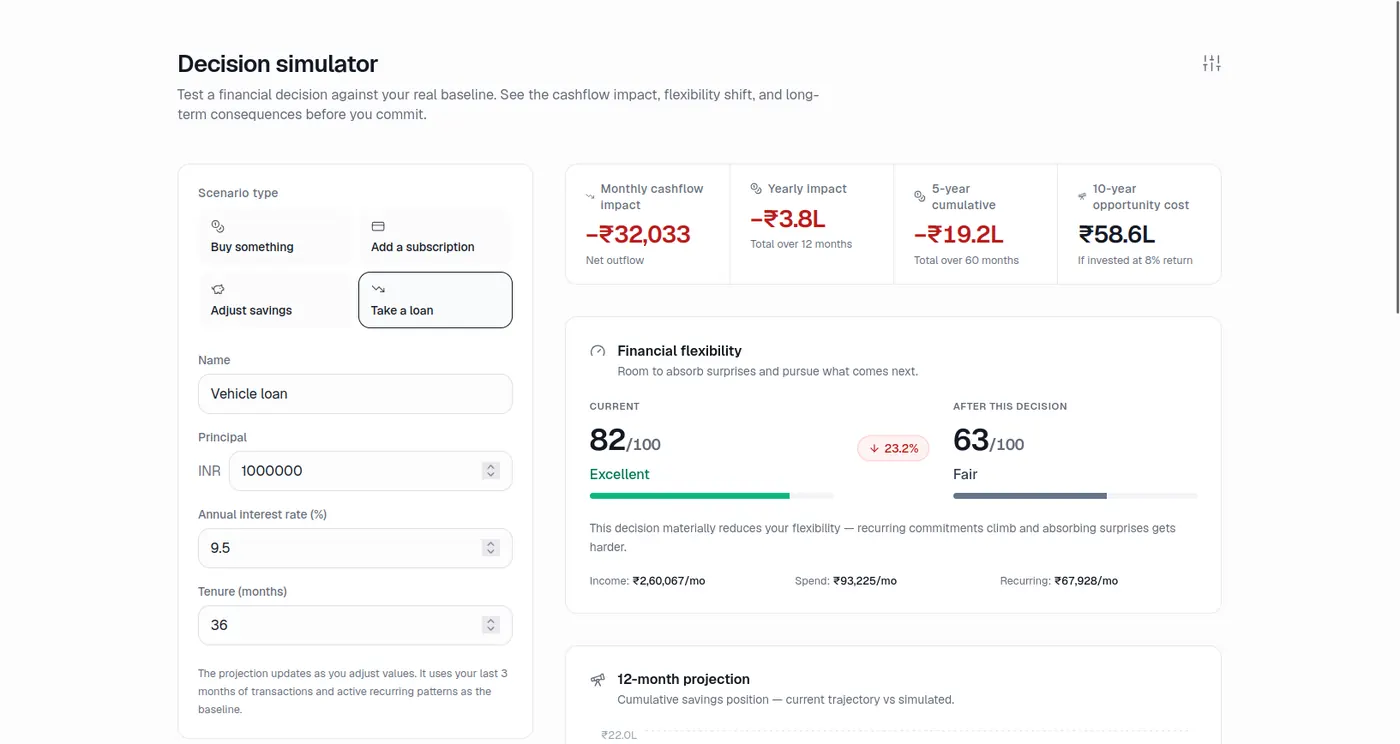
What exists today.
| Area | State |
|---|---|
| Engines — analytics, recurring, leaks, insights, simulation, reports | implemented |
| Recurring cadence tiers, weekly → annual | 5 |
| Brand-alias map for merchant identity | 80 entries |
| Schema migrations, validated at boot | Flyway V1–V14 |
| Tax sections detected, financial-year aware | 80C · 80D · 80E |
| Responsive web client, down to | 320 px |
CI builds and tests the backend against a live Postgres, type-checks, lints and builds the frontend, and builds the Docker images. Planned, not built: httpOnly-cookie sessions, cloud receipt storage (uploads are ephemeral on the current host), bank-SMS parsing, and operational monitoring.